Friday, October 28, 2005

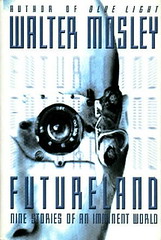
Commentary on Walter Mosely's 'Futureland'

futureland

"Futureland: Nine Stories of an Imminent World" is Walter Mosley's second science fiction book. Unike the title suggests, it is not a series of unrelated short stories. Instead, all the stories share the same world and have common characters and locations. This makes the book more like a novel which looks at the lives of several different people in order to fully examine the world in which they live, a generation after this one. In doing so, Mosley covers a very wide range of issues and makes some scarily plausible predictions about the direction in which we are headed. In a little over three hundred and fifty pages, he looks at the future of race, gender, global capitalism, the media, civil liberties, the American obsession with beauty and a host of other topics. What really makes it disturbing to read is the fact that, especially after the September eleventh attacks, it is already possible to see some of his predictions beginning to happen.

Mosley's characters are also an incredibly diverse and unusual cast, especially for a science fiction novel. They include factory workers, criminals, the smartest person on the planet, the first female heavyweight boxing champion and a futuristic replacement for Easy Rawlins. Also, they are are representative of the underclass in the society. They usually represent the common, even more repressed, people who live in that world and it is through them that he makes us aware of the injustices of his brave new world.

The nine stories that make up "Futureland" are entitled "Whispers in the Dark", "The Greatest", "Doctor Kismet", "Angel's Island", "The Electric Eye", "Voices", "Little Brother", "En Masse" and "The Nig in Me". I am not going to deal with each story separately because they share similar themes, the same environment and sometimes the same characters. Because of this, it makes more sense to consider all of the stories as one large novel and deal with it in terms of characters and themes rather than revisit the same themes over and over again in a variety of different scenarios. Obviously, I cannot cover all the themes that show up in this book since it is incredibly dense in the issues it covers. However, some of these themes receive far more attention than others so the focus of this paper shall be narrowed somewhat to look mainly at what I consider to be the most important themes in the book. These will be race, global capitalism and civil liberties. All of these themes show up in almost every story and so it makes sense to spend the most amount of time dealing with them.

Obviously, I am going to start off taking a look at the way race is presented in "Futureland". The very first story in the book, "Whispers in the Dark", gives us a very apt idea of what Mosley considers the fate of black people to be a generation from now. Namely, still an underclass. In the story, the smartest human being alive, Ptolemy Bent is born to a family too poor to afford the kind of education required by the state for someone of his intelligence. In order to keep him from being taken away, his uncle,Chill, a convict with no job prospects, is forced to sell several of his body parts ,including his eyes, spine, and penis, in order to keep the family together. According to Mosley, in their community this has become the norm for people desperate for money. In "Angel's Island", we see the inside of private-owned maximum security prison where, as usual, a majority of the inmates are people of color. In "The Electric Eye", we are introducet to Folio Johnson, the futuristic replacement for Easy Rawlins. We are also introduced to the International Socialists, a modern day version of the Nazi party who do not allow Jews in their party because "Zionism is incompatible with social evolution" . Later on in that story and in "En Masse" and "The Nig in Me", we are made aware of their plot to crate a race specific virus targetting black people. However, the virus mutates and instead kills everyone who is not at least 12.5 precent black. This solves nothing, however, as groups of 'white' looking survivors, hispanics and black survivors begin to fight each other showing that there is no easy answer to the question of race. As you can see from the title of his last story, the word 'nigger' has been shortened to 'nig' but still maintains all of the controversy about its use that it has now.

Capitalism and Globalization are two other concepts that show up in virtually every story. Curiously, Mosley chooses to call his Nazis socialists which indicates to me that he is not advocating any kind of socialist revolution. Instead he is just pointing out issues with the current system of capitalism in use pretty much everywhere and the direction in which it is going. One of the new concepts he introduces is the concept of companies having achieved sovereign status. The company he uses to illustrate this concept is Macrocode International,the largest company on the planet, which turns up in almost every one if his stories. In "Doctor Kismet", we are shown the sovereign island state that doubles as Macrocode's headquarters and we are introduced to its leader, Dr. Kismet. We also learn that the fastest growing religion on the planet is actually a Macrocode company. In "The Electric Eye", we find out that a branch of Macrocode is helping develop a virus targeted at black people. We also find out that there are only five independent restaurants in the whole of New York. All the others are members of one franchise or the other. Therefore, corporations have virtually wiped out independent traders. In "Little Brother" a follower of Infochurch, the Macrocode religion, is unwittingly used as a guinea pig to to test a Macrocode designed automated justice system for poor people. In "En Masse", we are given a very grim view of the life of the future worker. People are treated like machines and their every action monitored. Any kind of individuality or human contact is punished. Even hugging your spouse could violate sexual harassment policies. A lack of a job means a person goes into government sponsored housing and becomes a 'backgrounder', eating and sleeping in shifts to conserve space while having almost no hope of getting a job and returning to a normal life. In his world, the corporations legally control the people who work for them. Considering what I know of modern corporate America, it is not hard to see where these predictions come from nor is it hard to believe in their plausibility.

The final theme I choose to examine is that of civil liberties. Already, since September, there have been several attempts by the government to gain more control of its citizens at the expense of their constitutional rights. In "Futureland", this has been taken several very frightening steps further. The convicts in "Angel's Island"have had their constitutional rights legally revoked for the period of time that they are prisoners meaning that the prisons are the final judges of their fate. In this case they are all used as slave labor on a plantation. All citizens are implanted with tracking chips to make it easier for the police to keep track of their activities and the cities are patrolled by little spy cameras called 'nosers' which, like the video cameras going up everywhere today, keep tabs on people. It is also required that newspapers publish the names of anyone with a criminal conviction so employers can be sure the people they are hiring are not criminals. Again, these scenarios are a little too frighteningly possible, especially seeing how everyone is trying to cash in on the increased sense of vulnerability in this country following 9-11.

What makes this book so unsettling is how immediately possible it is. Mosley proposes very little that is truly revolutionary. Most of what he does propose is easily a very short step away from the world we live in now, which is incredibly scary. With luck this book will never come any closer to reality than it is now but I'm generally cynical when it comes to human nature so I'm not holding my breath.

Wednesday, October 26, 2005

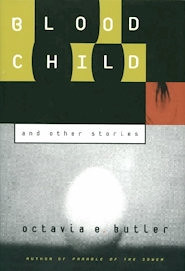
commentary on Octavia Butler's 'Bloodchild'

bloodchd

"Bloodchild and Other Stories" is a collection of five short stories and two essays. The title story "Bloodchild" has won her several awards since it was first published including the Hugo and Nebula awards, which are the equivalent of Pulitzers to Science Fiction writers. It is a heavily reviewed and analyzed work. The other four works are titled "The Evening, The Morning and The Night", "Near of Kin" "Speech Sounds" and "Crossover". All of these stories in one way or another deal with the dynamics of human interaction. "Crossover" and "Near of Kin" may not necessarily be considered Science Fiction stories. They fall more into the category of dramatic writing and have little in the way of Science Fiction elements in the way they are written. They are still incredibly good stories. Overall, there seems to be an air of pessimism that clings to her writing as though she expects very little of people especially in the way we interact with each other. This holds especially true for her depiction of relationships between men and women where the relationships invariably involve the woman being powerless and making the sacrifices in the relationship.

Octavia Butler is considered by many to be, along with Samuel R. Delany, the first generation of black science fiction writers. She is also considered a very important back feminist writer in some circles. Generally, all of her works that I have come across tend to contain elements that examine the power dynamics resulting involved in race and gender. Her best known works are "Kindred" and the "Parable" series of books comprising "Parable of the Sower" and "Parable of the Talents". These works deal a lot with themes of race and its scars on American society, gender roles and their associated power dynamics as well as numerous issues of social exploitation and the way human beings tend to relate to each other. I chose not to read any of those for several reasons. Firstly, I had already read them and didn't see the point in rereading works I already knew. Secondly, everyone reads those books. It made more sense for me to look to one of her less known but still respected works and maybe contribute, probably in a very minimal way, to the body of knowledge surrounding her works. There was also the fact that "Bloodchild" is her only collection of short stories and as such it would cover a wider range of topics than any one of her novels. Finally, I just like reading short stories so that book was more appealing to me.

The first story in this compilation is "Bloodchild", probably her most famous short story. The story takes a look at a group of humans forced to leave Earth for reasons that are never made clear. They are taken in by an alien race that keeps them in a 'Preserve' then uses them, primarily the males, to incubate their young in a process very similar to pregnancy and childbirth. The central character in this story is Gan, a young man coming of age who has been promised to the alien 'protector' of his family. The story focuses on several things simultaneously. On one hand, it is Butler's pregnant man' story about a man choosing to carry children out of love in a unequal relationship. Gan chooses, in the end, to not kill himself or his protector but instead to allow her to, in an almost sexual scene, implant her eggs in him. He does partly to protect his family and partly because he cant stand the thought of her being that intimate with someone else. On the other hand, it is a story about power dynamics between two different races where one has the power to dictate the terms under which the other shall live. The humans live a life slightly better than that of livestock where they are denied access to weapons and anything else the aliens feel they shouldn't have, can't leave their 'Preserve' and have to give up their children to act as incubators for alien children. In the end it is a truly disturbing story.

The next story in the collection is " The Evening, The Morning and The Night". This story deals with the experiences of a girl, who remains unnamed, born with Duryea-Gode disease. This is a fictional disease that causes a person to go crazy and attempt to dig their way out of their own skins, usually injuring themselves and people around them. As a result of how dangerous they are, they are forced to wear tags declaring they have the disease and are discriminated against and avoided by general society. She finds out in college that because both of her parents had the disease, she has pheromones which allow her to influence people afflicted with her condition. Butler's description of what her character goes through seems like it was taken from her experiences in college. All the college students with the disease are ignored and harassed by their fellow 'normal' students. A brilliant student talks about the fact that his genes will probably keep him from being accepted to medical school. They live as pariahs in a society that fears them. This kind of reaction plus their knowledge of impending death turns them into a group of very focused students and very productive citizens. The point of this , says Butler herself, is to examine how a person's genes can affect the path they choose to take in life. The other interesting point about this story is Butler's creation of a special group of women, a matriarchy of her own design, who tend to the sick in their community and who, ultimately, everyone in the community comes to rely on.

The third story in this volume is entitled "Near of Kin" I can't really characterize it as a science fiction story. It is more of a contemporary fiction story which focuses heavily on human relationships. As usual, Butler take on human relationships is more than a little cynical. The entire story revolves around a discussion between a young woman, also unnamed, and her uncle when she comes back home to bury her estranged mother. The conversation for the most part deals with her relationship with her mother. For the most part, she feels that the only reason her mother had her was to prove that she was fertile after she had miscarried four times. Later in the story it is revealed that she is actually the product of an incestuous relationship between her mother and her uncle and that the reason her mother avoided her may have been guilt over her conception. Since he mother is dead, all we have are two differing opinions on a very dysfunctional relationship. The daughter, who is hurt and bitter at being cast away, and the uncle, who still loves his sister and insists on her goodness. The relationship between the daughter/niece and the father/uncle is probably the most stable of those portrayed in the book all which isn't saying that much. They are both unsure of how to behave around each other because of the fact that their relationship is so unclear. Butler calls this her sympathetic incest story I find it sad that there is very little in the way of redeeming human relationships in the story.

"Speech Sounds" is the title of the next story. It is a grim story of a world where a strange new disease has either killed people or taken away their language ability to some degree. Some people are more affected than others but the disease hits men the hardest. The protagonist of this story, a woman named Valerie Rye, retains her ability to speak and understand spoken language, a fact she hides from the rest of the world for her own safety. In the course of the story she meets a man she calls 'Obsidian' who retains his ability read and write and continues to lead a life as an LAPD officer despite the fact that all law and order has vanished. This story is used to examine a number of themes. Among them is the idea of how little removed human society is from savagery and lawlessness and how much violence is caused by people's envy of each other's position. Rye is forced to conceal her ability to speak since it will probably get her killed. When she first finds out about Obsidian's ability to read, she initially feels jealousy and hatred. He is also initially envious after he finds out that she can speak and these are the two most sane people we are shown in the story. All the other men in the story are, for the most part, violent and irrational. All the other women in the story are basically trying to survive and willing to take any man who will have them because of the shortage of men. We see Rye court Obsidian in order to get him to stay with her. She knows he probably wont stay for long but she is willing to have him for as long as he wants because he is better than most of the men she's met. In the end, the story is another incredibly well written but pessimistic look at human relations.

The final story in this compilation is entitled "Crossover" which, incidentally, is one of the first short stories she ever sold. It is another that doesn't really qualify as a science fiction story. Its more of a story of the person she was afraid she would become if she didn't become a writer. In that way, I suppose it could qualify as an alternate history. The main character is another unnamed woman. She has a dead end job in a factory which she hates and lives in constant fear of loneliness and death. She plans to kill herself but is too scared of dying to do it. As a result of a disfigurement, she suffers from serious self esteem problems and does not consider herself to be worth the man she has so she drives him away. In the end of this story we see her behavior getting even more self destructive. Butler says in her commentary on this story that the fear of becoming someone like this is what kept her writing when she worked under similar circumstance. It makes it easier for you to understand the focus that turned her into one of the best science fiction writers of our time.

One could get the idea from my opinions of the stories that I don't like them. On the contrary, I think they are incredible, if cynical, examinations of human power dynamics. While they are kind of depressing in their conclusions on the fate of humanity in general, they are also hopeful that there might be a change in the way we treat each other.

Slight shift in schedule

I started writing the Race and SF post, but found myself overwhelmed by all I wanted to talk about and caught up in the wide range of possible directions I could take the post in.

There was also a little more anger than I expected. I'm going to attempt to refine what I have and give it focus in my free time tomorrow.

In the meantime, I Figured I'd keep my word to a couple of people, including Pam, and put up something from a series of papers I wrote in my senior year of college as part of a privatereading I took examining black science fiction. Basically I reviewed a series of books and discussed the issues they adressed, then used them all together to write a paper on the varied ways they all tended to deal with the issue of race and other important themes.

The books were(in no real order)

'Bloodchild and other stories' - Octavia Butler
'The Intuitionist' - Colson Whitehead
'Lion's Blood' - Steven Barnes
'Skin Folk' - Nalo Hopkinson
'The Gilda Stories' - Jewelle Gomez
'Futureland: Nine Stories of an Imminent Future' - Walter Mosely

I'll probably put up a new essay every couple of days until they are all up. I hope you find them interesting

Monday, October 24, 2005

Topics for this week:

Martial arts (Partly inspired by Mushtaq's recent posts)

and the eternally underdiscussed issue, race and speculative fiction (partly inspired by issues surrounding Anansi Boys, partly just stuff I keep meaning to mention)

there might be the odd personal note in there too

I hope you like it

Saturday, October 15, 2005

Anansi Boys

dedication

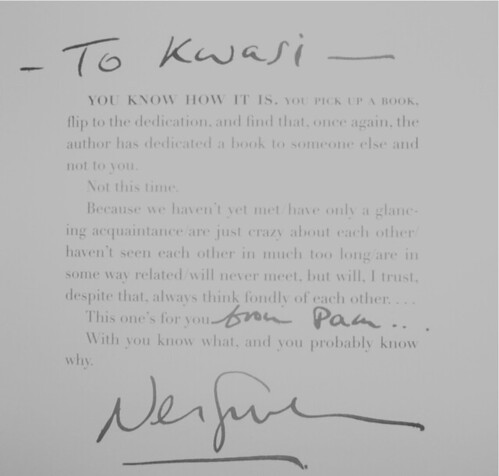
I think this may be the second or third time I'm gloating on here about having the book signed to me. This is definitely staying high on the list of things I am thankful for. As is becoming common for this blog, it gets a brief review, and a brief note on issues I'm becoming aware of surrounding the ethnicity of its protagonists (basically the fact that the book is about black people is churning up various issues for various reasons. I'll address one of them)

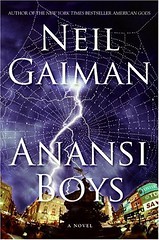
Ok, so a brief review. As I'm sure you are all aware, the book is about a man everyone refers to as Fat Charlie, who is, unknown to him, one of the two sons of Anansi, the trickster god who I grew up hearing stories about. Charlie finds out about his father, as well as the existence of a brother he never knew of, when his father dies suddenly.

As a result of his father's death, Charlie meets his brother Spider, who inherited their father's magic and his love of tricks. As a result of meeting his brother and being made aware of his family's legacy, Charlie's life goes through a series of rapid, unexpected changes that take him from London to Florida to the Caribbean in an effort to get himself out of trouble, understand his new life and come to terms with his family.

Now, I've always been a huge fan of Neil Gaiman. Partly because he's one of the best writers I've ever come across when it comes to harnessing the power of myth to tell a great story and make it seem almost commonplace. I'd put him up there with Nalo Hopkinson and Terry Pratchett in that respect. Which reminds me, on the off chance he'll ever come across this, *some* people are still waiting for another 'Good Omens' style collaboration and I think we've been more than patient.

Part of the reason this book strikes a chord with me is the fact that Ananse stories originated among my father's people. This is a piece of mythology that I am really close to and I'm delighted to see non euro myth handled with this level of respect and sophistication. I have a sneaking suspicion though, that his use of a fairly 'obscure' piece of African and Caribbean myth to power his story will receive some some comments a lot less positive than my own.

And finally, my tiny commentary on color issues surrounding the book. I ran across mention of the fact that there is very little to suggest that Charlie is black in the way the book is written. Obviously it can be inferred from the fact that his father is descended from an African myth that he must be at least biracial, but very little mention is actually made of colour in the book. The fact that its even worth mentioning says a lot about how the 'default' visual for a person is always white if they are without explicit ethnic descriptors, especially in a genre as whitewashed as science fiction. I have to wonder if that was done deliberately to feel out people's reactions or whether it was a side effect of Neil Gaiman being Neil Gaiman. Either way, it didn't interfere with my enjoyment of the book since I assumed Charlie was going to be black anyway. In fact I didn't notice it until after I was done with the book. It is something I expect black science fiction fans will talk about to a degree either way.

Thursday, October 13, 2005

My Fledgling review

Octavia Butler - Fledgling

In the last week or so I've gone through two books in my spare time. Of course by spare time I mean time I was supposed to spend asleep. Still, it was Neil Gaiman and Octavia Butler. What is sleep measured against those? Plus *sigh* I'm an addict. I literally have to make myself put books down every time I walk into a bookstore. I need to find a good used bookstore in the area, my collection has giant planet sized craters in it.

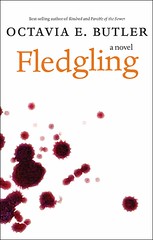
Anyway, back to the book. Octavia Butler's 'Fledgling' joins a select few books that I actually bought in hardcover and I'd say its worth it. The story is basically about a young girl, Shori, who wakes up one morning badly wounded and with no real memory of who she is or what happened to her. Over the course of the book we find out that she's actually a vampire and someone means her serious harm. By the end she gets a much better idea of who she is and manages to save herself and those she cares about from her enemies.

The real point of any Octavia Butler book, though, still remains how she handles issues like race, gender and the family structure. Shori is a product of an experiment to produce vampires capable of surviving in the sunlight for at least brief periods of time. In order to do this, vampire DNA is mixed with that of humans. Not just any humans, but black people. Shori is literally one of the first black vampires. As you can imagine, this tends to create a little bit of an issue with more conservative members of the community.

As for family structure, it continues the theme of matriarchal extended family systems that have shown up in several of her other books and short stories. She makes it a point to fully flesh out the dynamics of how such a system would be run, including possible issues with jealousy.

I should point out though, that she continues excel at writing sex scenes that genuinely creep me out. I'd explain why. Still that's just a quibble, and not even a good one, because my sense it that the sex scene in question was meant to disturb.

Its still a great book, and one I'd definitely recommend even if it means waiting for the paperback.

Thursday, October 06, 2005

Tagged

Tiel passed me a meme, which I shall now infect others with

Seven things I plan to do:
1. Stop doubting myself
2. learn Mandarin, Spanish and Swahili
3. get a teaching certification in Dachengquan
4. Fight in some amateur san shou competitions
5. Get a science fiction story published
6. Learn to code at an advanced level in Python
7. Become a decent freerunner

Seven things I can do:
1. cook a decent meal
2. make people laugh
3. get myself into trouble
4. dance pretty well
5. soak up information like a sponge
6. Build a computer from parts
7. be brutally honest

Seven things I can't do:
1. walk into a bookstore, record store or comic book store and leave empty handed
2. a full side split (sadly, not even close)
3. not overthink things
4. not treat people as individuals
5. draw a perfect circle or straight line
6. be hurtful without provocation
7. understand animals

Seven things I say most often:
1. oh s*&t
2. in my opinion
3. ummm....
4. no offence but...
5. its not that deep
6. I need to train more
7. I need sleep (usually really late at night when my eyes refuse to focus)


Seven people I want to pass this tag to:
SB
Jef
Pam
Minister Faust
DJ Rue
........
any of my readers want a spot, comment and I'll be more than happy to slide you on

Wednesday, October 05, 2005

Counting my online blessings

anansi boys cover

For those of you who also check out Pam's blog, you already know that she outdid herself, and won me as her eternally grateful servant, by getting me a SIGNED COPY OF NEIL GAIMAN'S ANANSI BOYS!

Yes, its in all caps, something which I generally have a firm rule against doing anywhere. That's how excited I am and how much this means to me. I literally don't have the words to properly say thank you. So I'll settle for putting it up someplace everyone is bound to see it. I will pass the favour on, and the first chance I get to return it I'll do that too.

While dancing about the house (literally) in joy, it occured to me that I have been very fortunate in my online interactions with people. The least of my fortunes have been the things people have sent me. Including, but not limited to, the complete run of Gary Phillips' 'Shot Callers' for my growing black comic creators collection and the hugely informative Guide to getting it on! (probably the most you'll ever hear me say about my sex life, at least for now)

At a certain point in my life I was very much in danger of becoming a hermit and a misanthrope, and yet I have been fortunate enough to constantly run into people who remind me how much kindness and genuine humanity there is out there, both online and in real life. For that I thank you all.

Saturday, September 24, 2005

ooooh

BP figurine

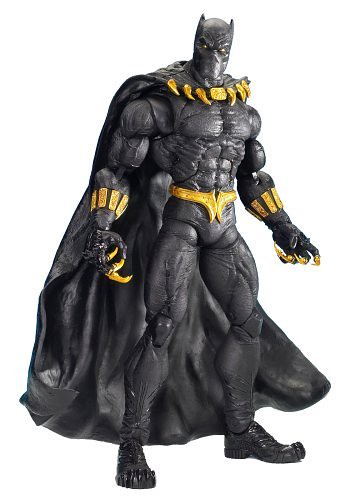
Guess what I'll be getting myself next month

*geeked*

Friday, September 23, 2005

Why wasn't I notified?

Octavia Butler - Fledgling

Apparently Octavia Butler's new long awaited book 'Fledgling' which also happens to be about vampires is already out. I'm usually all over these things. Plus I've been waiting for this one for a while. How I lost track of it is shaping up to be one of the universe's biggest mysteries.

I plan to get around to reading that pretty soon. Usually I'm opposed to buying hardover books because of how bulky thay are and the price premium, but this is Octavia Butler so I'll make an exception.

Wednesday, September 21, 2005

Another book I've been reading

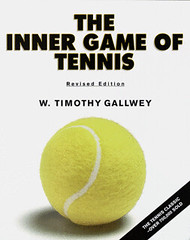
The inner game of tennis

No, its not the tale of the warrior women. Expect that in about two weeks or so. Instead, today we shall be talking about a much older book that was given to me by my aunt (for which I'm extremely grateful)

Timothy Gallowey's 'The Inner Game of Tennis'. I'm pretty sure some of you have read this before since it has been around for a while. For those of you who haven't, If you have any interest at all in any discipline that involves human movement, or in just gaining a better understanding of how your mind works, I'd advise at least checking this out of your local library.

The philosophy behind it seems to be derived from Buddhist thought. Its purpose is basically to get us to let the ego step aside so that the part of us that actually learns and acts take control. One of the interesting things about this method seems to be how much it affects the learning curve behind physical activities. As I read the book it was easy to look back at my past and realize how certain breakthrough moments in martial arts classes had been because of my ability, for a brief while, to live in the moment the actual movement was taking place without any form of fear or doubt.

What he tries to do in the book is provide suggestions on how to take that moment of absolute concentration and expand it so that it becomes a part of how we live rather than an occasional accident. While his examples all had to do with tennis, the basic principles and concepts he used are widely applicable. I'm working some of them into my daily practice to see what they can do for me.

Bottom line, read it. Worst case it'll be an interesting read with no new information. Best case, it'll make you change how you think about the process of learning/living.

Friday, September 02, 2005

On: The tragedy of mismanagement that is Hurricane Katrina

This article is by a man who I have a great deal of respect for. It should be showing up on The Independent Weekly at some point soon but I saw no reason to wait.

Welcome To The Terrordome:

Race, Class, Misplaced Priorities and Optional Tragedy.

I am, saddened, appalled, outraged and disgusted at my government’s gross negligence, monstrous mismanagement and callous indifference toward the victims of Hurricane Katrina. I am, at this moment, ashamed to be an American. And let me say, preemptively, that if anyone replies “well get out then” I will punch you dead in your face. Yes. It’s that real.

My initial response, like those of most of us who follow human tragedy, was one of shock, pity, empathy. From whence, then, comes this wave of anger, this storm surge of emotion seething within me that threatens to overcome my better nature? It comes with the realization that, despite the capricious and uncontrollable nature of the hurricane, the vast majority of the tableau of misery that plays out before us represents an Optional Tragedy. Examination of the facts that lie in the background, below the din of sensational news headings, reveals a truth irreconcilable with the lofty ideals that we export around the world at gunpoint: these people are dying mainly because they are poor, and black. Beyond that, though, and not contradictorily, these people are also dying because of the historic ineptitude and criminal indifference of a Bush administration that has made the Federal Emergency Management Agency a slavish servant of their idiotic ideology.

Optional? Yeah. In the earliest days of the news coverage, reporters and talking heads parroted lines about people who decided to ‘ride it out’, as if the majority of the people in the path of Hurricane Katrina truly had a say in the decision. The 2000 census listed New Orleans’ population at 485,000, with 27% below the ridiculously low federal poverty level. That works out to about 135,000 people, not counting others who may have slipped below the line during our past five years of prosperity. The median income in New Orleans is $27,000, so half of those 485,000 people made less than that. And that says nothing of the surrounding areas of Louisiana, or of those living in Mobile, Alabama, Biloxi, Mississippi, or in places so remote that they are not even on the national radar.

How many people in households making $27,000 a year can afford to just up and take a few hundred-miles trip on a couple of days’ notice? Unlike a handful of adventurers and some hardheaded veterans of hurricanes past, these people were not trying to ‘ride it out’, they had no ride out. Assuming, they did have a car, in reliable, working condition, could they afford a tank of gas, at over $2.50 per gallon? A hotel stay? Don’t kid yourself. They didn’t choose to stay, they were Left Behind, like those forsaken by God in the best-selling fictional biblical account of the ‘end times’. These souls were not Left Behind by God, though, they were left behind by their fellow man.

The only ‘option’ exercised was the option of the various city, state and federal emergency management agencies to NOT provide for their evacuation. There should have been convoys of buses and military transport vehicles BEFORE the hurricane, offering transport to safety for any and all citizens. And yet, on Tuesday I was hearing news anchors asking the dim, but by then-rhetorical questions of “Why didn’t they leave?”, leaving talking heads and studio experts to explain that economics played a major part, while giving no specifics, and allowing unsophisticated viewers to guess for themselves how many were dirt poor versus those who were hardheaded, and kinda ‘got what they deserved’.

What they SHOULD have been discussing was why nothing was done by the government to provide transportation for these people to get them out of harm’s way. Hmm... Save that for angry editorialists to hash out in long-assed columns. But I don’t really expect much depth from national news media these days, so that, while disappointing and maddening, it was not surprising. What was absolutely shocking, however, was to hear Michael Brown, Director of FEMA, on Thursday evening, following a live CNN broadcast from the convention center in New Orleans, speaking, repeatedly, in terms of people who “CHOSE” to stay. Even after the anchor, to his credit, corrected him and mentioned the poorest of the poor status of those Americans living in Louisiana, Alabama and Mississippi, Brown stubbornly or ignorantly continued to use the word “chose” to describe why the people were in the path of Katrina’s wrath.

More appalling, however, was that he, the top FEMA official, did not know until hearing CNN’s report in the background that there were thousands of people who had been stranded at the New Orleans Convention Center for three days without food or water. YOU CAN’T EVEN WATCH CNN?? That really inspires my faith in our government’s resolve.

The herding of people into the Superdome was an act of desperation, necessitated by the utter lack of a plan to evacuate people who had no transportation from the city. The president, dull-witted as ever, proclaimed on Thursday that, “I don't think anyone anticipated the breach of the levees."

You don’t think? I’ll buy that. It didn’t cross your mind while playing golf, on yet another of your record number of vacations. And you must have MISSED the news I watched, which, following Katrina’s deadly romp through Florida, warned that a Category 5 hurricane would destroy New Orleans as we know it, by destroying the levee and canal system. The president could have also looked at disaster readiness reports from FEMA in 2001 (pre 9/11), which listed a category 5 hurricane in N.O. as one of the three likeliest, most catastrophic disasters facing this country.

Can’t recall when you saw that report, Mr. Bush? It was after you appointed a political crony with no disaster management expertise (your former Texas chief of staff John Allbaugh) as director of FEMA. And before you downsized FEMA from a cabinet level department and made it part of the Department Of Homeland Security. And before you started your optional war in Iraq (which by the way, is where 35% of the disaster area’s National Guard troops are). It was also before you decided to privatize the agency, and contract out a lot of its function. And definitely before this June, when you slashed the New Orleans’ Army Corps Of Engineers budget by $71.4 million, including money designed to prevent floods and shore up the levees.

Bush’s administration in 2001 decried that FEMA could engender a ‘culture of entitlement’ (what’s all that ‘provide for the common defense and promote the general welfare’ stuff about, anyway?) among citizens. Under the savvy direction of Allbaugh, armed with no disaster training but good ol’ Texas business know-how, FEMA reckoned it could save $200 million from its budget by cutting so-called ‘mitigation’ strategies, grants used to essentially help prevent disasters, by moving people from flood plains, and making improvements to local infrastructure and emergency facilities. $200 million is paltry (I daresay, niggardly), compared to the billions of dollars of damage that hurricanes do to our increasingly built up coastlines. The old chief of the New Orleans Army Corps of Engineers quit over the continual slashing of his budget and the tying of his hands regarding flood preparedness. The current chief stated on national TV, after the levee breaks, that they were only built to withstand a category 3 hurricane, and that was ok, because it was an acceptable risk for the money they had to spend. If he were in corporate America he’d be soo fired. As it stands, he’ll probably be promoted.

I’ve learned all of this troubling information after the fact. It is infuriating enough. But to juxtapose this record of governmental malfeasance with the images and reports, first trickling, now pouring, from the Superdome? Putting them there was desperate and, by definition short term. I worried when they said folks needed to bring their own food. But with no running water (ie, no working bathrooms), and no electricity, let alone AC, or food, or drinking water, the place has become the Terrordome, a brooding, stinking cesspool of people cramped together in ignorance and uncertainty, and increasingly littered with corpses of victims of the colossal ineptitude of the public officials paid to protect and serve them. The conditions are not only worse than those of any prison in the US, if the inhabitants were rottweiler or pitbull puppies, the ‘owners’ would be arrested for cruelty. They are sitting and sleeping in their own feces because their government said “come here and we will help you”, and then never came back. Even slaves had water, and enough gruel to sustain the strongest through the Middle Passage.

We, who can project our military might all the way around the globe, could not get troops there right after the hurricane, and buses, and amphibious marine transports to get these people out? Had they done so, and not left some of those Left Behind to play out this sick, Lord Of The Flies type scenario (with Wal-Mart guns), perhaps some of these suffering people would not have been doubly and trebly victimized?

I see children on tv screaming “help us” and sad-faced news people zooming by in their vans, footage in the can. I see looped footage of looting, as if stealing t-shirts (or, stupidly, tv’s) somehow justifies the treatment of the miserable yet law-abiding masses of people waiting to die in the hot sun. People forced to push their dead grandmothers off into a corner, against a wall, so the stink of her body does not overpower those still hanging on. People who have climbed through roofs and slid through windows with jagged glass, untreated, or waded through waist high filth, to have guns drawn on them by cops threatening to shoot them for taking the only available food from stores that will never see another customer. And the many people who have waited for days for buses that did not come and who have literally dived off of the elevated highway ramps to their sacrificial death on the hard concrete below, on the altar of inhumanity, indifference, and misplaced priorities. Hard concrete. Like the hearts of those who say “we’re doing all we can” but who expect us to believe that a single gunshot warrants turning around a National Guard helicopter, thwarting these ‘heroes’ from rescuing old ladies and babies on hand-cranked life support, when their brethren face far more danger in Iraq, ducking bombs and bullets for no good reason.

“They chose to stay”. No. ‘We’ chose to leave them, and every death of a person who could have been evacuated, before, or right after the hurricane was optional. Governors have called this ‘our Tsunami’ as they fly safely over the carnage. No. That is not quite right. Death, in the Tsunami, was democratic. The super rich and abject poor alike were swept away with little to no forewarning. No. Here, in the world’s biggest self-promoting democracy, we had options, and, like so many of our policies and politicians on a daily basis, we opted not to give a damn about our poor. And so they died. And we wring our hands about gas prices. Every needlessly dead person’s body should be piled at the feet of the irresponsible officials. So they can ponder their options.


Derek M. Jennings

You have the option to stand up for those who are not being heard. Write or call your congressperson, the White House, major news agencies and your friends. Inform them of what is really going on, how it looks to you, as a citizen, and how it looks to a world which is probably as saddened for our loss as they are to see that we have yet again spectacularly failed to live out our ideals and our professed faith.

Make yourself heard:
http://www.senate.gov/general/contact_information/senators_cfm.cfm
http://www.house.gov/writerep/

More Info:

http://www.washingtonmonthly.com
http://www.indyweek.com/durham/2004-09-22/cover.html

NPR story from 2002 on possible results of a category 5 hurricane striking New Orleans. The closest thing to prophecy I have heard in a while: Part I Part II

Wednesday, August 31, 2005

Interesting.....

Concerning news coverage of the hurricane. Look
here
here
and here

I'd rather not editorialize on this. Draw your own conclusions first

Pam knows Lenny Henry?

chef!


How do these kinds of incredibly cool things keep happening to me? First one of my favourite uncles (also a physicist, btw) turns out to be a close college friend of Avery Brooks, and now one of my favourite online people turns out to be friends with one of the best british comedians of all time?

For those of you who do not know who Lenny Henry is, I could talk for hours about the comedic genius behind 'The Lenny Henry Show' and especially Chef! but instead I'll just point you here. Buy that box set. And if you are feeling generous, buy me one as well.

If you are any kind of fan of the kind of sarcastic british humor present in shows like Fawlty Towers you should love this. It is one of my lifelong dreams to be able to insult another human being with that level of eloquence. Not exactly discovering gravity, but it'll be fine with me.

Geek sidenote: Roger Griffiths, who played the character of Everton in Chef! also appeared in Batman begins as the cop talking to Gordon and his partner when they arrive at Arkham Asylum. That was a cool moment for me that not too many people got.

Other sidenote: I missed the audiobook link for chapter one of Ananse Boys. As I am a huge Neil Gaiman fan could someone please send me a copy?

Wednesday, August 24, 2005

Strengths I forget I have

I used to be scared of the dark.

As a child there was nothing scarier to me than the absence of light. I always had a very active imagination, especially back then. Couple that with the standard stories every Ghanaian kid hears about witches, ghosts, evil spirits etc. and its not too hard to imagine what type of nighttime horrors I was coming up with to keep myself awake.

Somewhere along the line my father found out about this. I can't remember if I told him or if he just figured out that I was scared of going to sleep. Either way, I remember us talking about it, and him telling me that the fear was just in my head and telling me that I could either stand up to it or be afraid of the dark for the rest of my life.

Then I remember night after night when I'd go into the bathroom (the only place in the house where I could get any privacy) turn off the lights and just sitting there getting to know my demons.

It worked. Today I actually like the dark. I function as well at night as I do in the daytime. And I discovered I have really good night vision.

Somedays I need to remind myself that I'm still that same kid. A little older and with a new set of demons, but just as capable of facing them now as I was then

Sunday, August 14, 2005

The need for certainty

Another post inspired by that colossal procrastination machine I call Okayplayer.

I had the evolution vs creation argument again this week. Actually, more than once. In the process of those arguments though, I came to realize a fundamental truth about mindsets I consider intolerant, whether religious or secular.

Sidenote: Although it is not said often enough, the legions of atheists and 'skeptics' who spend every waking moment not just pointing out inconsistencies in religions but believing that they have truly found the only way are guilty of the same hubris they charge religious extremists with. Namely believing that their way is the only way. The choice to believe in no god at all is just that, a choice. Since science, which a lot of them deify without understanding, IMO, makes no statements either way about the existence of a god, any arguments for either side are philosophical in nature and have little to do with proof. If you take a stand on either side you do it out of faith.

Now, there tends to be the same core mindet behind the wholesale unquestioning embrace of any particular religion, philosophy, political party, economic system etc. Namely, the idea of certainty. A group of ideas that can not be questioned and which are always appropriate regardless of the context in which they are applied.

Now, personally, I tend to apply certain aspects of the scientific method to real life. Particularly the part that requires that we consider all ideas subject to change. Also the part which requires we honestly admit what we do not know. I've always believed that before any kind of learning can happen, I must be prepared to admit my ignorance. This is not to say that I've never been ashamed to admit ignorance, or gotten my ego tangled around an idea to the point that I was unwilling to change it, but I try.

I see the need for absolute unshakeable certainty in anything as a very dangerous thing. You have to wonder how much of the ugliness in human history could have been prevented by someone just considering the possibility that their beliefs could be wrong. Its impossible to empathize with another human being so long as you believe only your perspective has validity.

Tuesday, August 09, 2005

Thank you Pam!

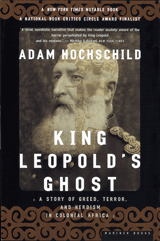
leopold

I would have done this sooner but the house hasn't had internet access for a week and I've been too busy when I'm on campus to post from there.

About a week ago, I came home to find an Amazon.com package with my name on it. This was really surprising to me since I hadn't ordered anything from them recently. Upon opening it, I found a copy of 'King Leopold's Ghost' which was on my wish list. When I checked the invoice I noticed that it was from the always fascinating Pam over at And We Shall March. Honestly, I was speechless That was the nicest thing someone had done for me in a long while. Especially since we only know each other in the context of what we write in our individual blogs and the comments we make to each other. Well, mostly the comments you make to me.

The book itself is remarkably well written and researched. It takes a particularly sordid period of world history and presents it in a straightforward but really engaging manner. I'm not yet done with it but have absolutely no issues recommending it based on what I've read so far.

Just so you know Pam, I am deeply grateful for the gesture and it is one that I shall remember for a long time. I'll also buy a copy of your anthology and review it on here. Actually I was going to do that anyway. I have a weakness for westerns.

While we're talking books, how is 'Amazons of Black Sparta'? I'm considering sliding it in among my textbook list for the semester.

Tuesday, July 19, 2005

Another Book post: Black Inventors in the Age of Segregation

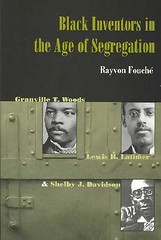
inventors

The other thing I've been reading recently is Rayvon Fouche's Black Inventors in the Age of Segregation. It takes a look at the lives of three turn of the century Black American inventors, Granville T. Woods, Lewis H. Latimer and Shelby H. Davidson.

The greatest thing about this book is its scope and the depth of research that obviously went into writing it. Fouche isn't happy with just rattling off a list of inventions and the circumstances under which they occurred. Instead there is a detailed look at the circumstances surrounding the life of each inventor. This ends up involving the most detailed historical account of turn of the century upper class, educated Black America that I have ever come across. He also goes into great detail about the personal politics of each inventor and their engagement, or lack thereof, in the civil rights movement. Its interesting how little has changed philosophically a century later. In the end, we get a living, breathing image of these men and the world in which they lived that is absolutely fascinating. For anyone with an interest in history its a great read.

Monday, July 18, 2005

Another Comic Book Post: Fierce

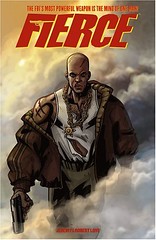
Fierce


This weekend, I ended up in New York City hanging out with an old friend. While I was there I passed by Midtown comics specially to see if they had a copy of the Fierce Trade paperback. Fierce is a product of Ghettosake comics(link in sidebar), the brainchild of brothers Robert and Jeremy Love.

The plot is action movie fare. Actually, the entire movie has an espionage thriller type feel. It would work great as a movie. Jamaican-born psychic Jonathan Fierce work for Razor, a special FBI unit. Someone betrays the unit and they all end up dead except for him. In their search for vengeance, the former members of his team all lend him their skills, turning him into a world class shot, hacker, martial artist, explosives expert and driver. With these new skills he returns to Kingston to find out who betrayed his team and exact bloody revenge. As with any good story, there is also a romance between him and the FBI psychiatrist assigned to help him deal with his psychic visions.

The writing is pretty much what you'd expect for something this action oriented. Its enough to develop the characters and make us empathize with them, but not so much that it interferes with the action. The great things about this book are the art and the action scenes. Every single panel is beautifully drawn. Honestly, I can skip the words and just enjoy the images. That's really rare for me. Usually I'm more about the writing than the art. As for the action, like I said before its more than ready for the big screen. I was really impressed with how well the scenes were imagined. I'm guessing the brothers are both huge film buffs. Either way, this takes up a well deserved spot in my collection and I have no qualms about recommending it to anyone.

Sidenote: Below is the cover of Ghettosake's next project, Chocolate Thunder. Its supposed to be a mesh of blaxploitation and martial arts movies on page. Personally, I can't wait.
I also picked up the first issue of Kyle Baker's latest project, Nat Turner. Seeing this art makes me wonder why he was unable to turn out work like this for Marvel's 'Truth' miniseries
Chocolate Thunder

Wednesday, July 06, 2005

My long awaited bookreview

Coyote Kings

I was supposed to get this out a week ago. I've already finished two other books and am working on a third. This still remains so far the best book I've read this year so I owe it some publicity.

"The Coyote Kings of the Space Age Bachelor Pad" is the first published work by black Canadian radio personality Minister Faust. You'll find a link to his blog on the right. I first came across this book while reading Nalo Hopkinson's blog a while back. I kept meaning to pick it up but then school started up and left me with almost no time for anything else. This summer, my local Borders had it on display so I scooped it up and was sucked in straight away. Of course with recommendations by Sheree Thomas, Tananarive Due, Steven Barnes and Nalo Hopkinson I really should have expected that.

The plot is basically about the coyote kings, two friends named Hamza and Yehat. Yehat is an engineering genius who builds remarkable inventions as a hobby and yet works as a video store clerk. Hamza is a brilliant writer who got kicked out of college just shy of his english degree and now works as a dishwasher. In their spare time they run a school of sorts for the kids in their extremely racially diverse neighborhood. They're both damaged in their own ways, but they are always there for each other. Into this weird frindship comes Sherem, a mysterious woman who hamza immediately falls for and who leads them both through a wild and supremely entertaining adventure.

So...... what do I like about this book? Well for one, its written by a fanboy who isn't ashamed to be a fanboy. Its chock full of references to Star Wars, Star Trek, Babylon 5, RPG's, comics, De Niro movies and lots of other nerd pop culture icons. In addition to that, it unashamedly afrocentric in its focus and setting. As much as most SF fans would deny it, a vast majority of the genre is written with western perspective. This book is one of the few out there that considers things from a different cultural context altogether. Although I have slight issues with the focus on Egypt that tends to dominate popular afrocentric thought I still like the idea of other cultures getting a chance at the spotlight. Above all though, its just very well written and is one of the few books I've read recently that made me feel the emotions it was trying to convey. If for no other reason than that, its worth the money.

Sidenote: I was surprised to see that this wasn't published by Warner Aspect (long stary. Anyone who was around during the 'race and science fiction' discussion on Steven Barnes' blog knows what I'm talking about) Hopefully this means I can expect more mainstream recognition for black writers in the genre.